Bike Maintenance on the Road: Fixing a Flat and Daily Checks
A step-by-step puncture repair, plus the daily and mid-trip checks that keep a touring bike running on Irish roads. Tools and spares list included.
Introduction
Most punctures on an Irish holiday come from the same few things: hedge cuttings on a back road in late summer, broken glass at the edge of a wet town street, a thorn that works through the casing an hour after you picked it up. It will happen somewhere with no phone signal and probably in drizzle. With a spare tube, two levers and a pump it costs you ten minutes. Without them it costs you the afternoon.
Damp is the other constant. It strips dry chain lube inside a day, and grit off wet roads chews through brake pads faster than you would expect at home. Neither matters much if you carry a rag and look at the bike each evening.
Why Maintenance Matters for Irish Cyclists
- Safety first: Properly inflated tyres and well-adjusted brakes reduce the risk of accidents on wet Irish roads and rugged off-road trails.
- Performance: A clean, lubricated drivetrain ensures smooth shifting, especially on steep climbs in the Midlands.
- Economics: Regular care prevents premature wear; a simple tyre sealant can save you the cost of a new tyre, which averages €45-€70 in Ireland.
- Environmental impact: According to Transport for Ireland, cycling removes 680,000 cars from the road each day in the country’s five largest cities, underscoring the need to keep bikes in good working order to maintain this benefit.
Fixing a Flat Tyre: Step-by-Step
Based on the detailed guide from Trek Bikes (Ireland) and common practice across the UK/Ireland.
What You’ll Need
| Item | Why It’s Essential |
|---|---|
| Spare tube (Presta or Schrader, matching tyre size) | Quick replacement if the puncture can’t be sealed |
| Tyre levers (2-3) | Enables safe removal of the tyre from the rim |
| Portable pump or CO₂ inflator | Restores pressure on the road |
| Patch kit or tyre sealant (optional) | Allows repair without swapping the tube |
| Multitool (Allen keys, chain tool) | For minor adjustments while on the move |
All items should fit in a jersey pocket, saddle bag, or a small frame-mounted bag.
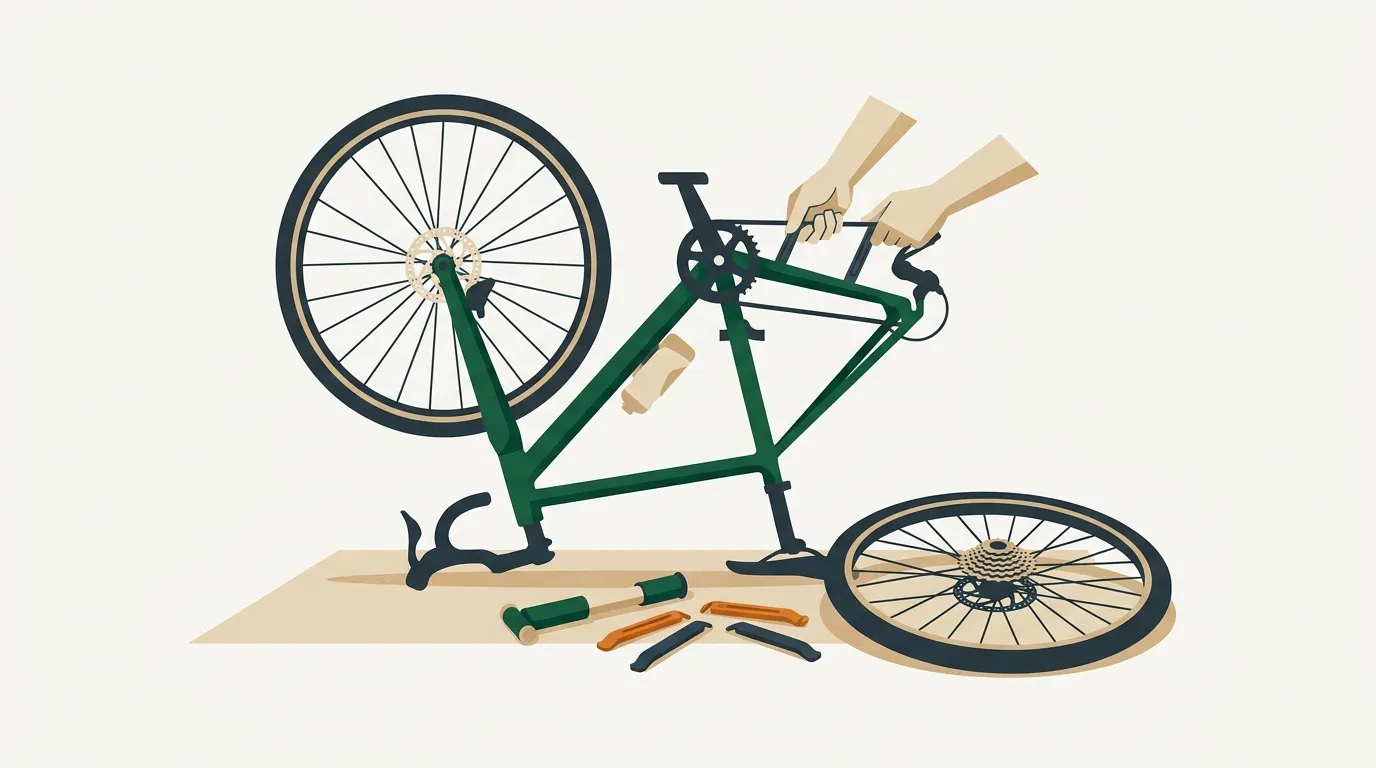
The Repair Process
- Safety first: Move to a safe spot, away from traffic. Turn off any electronic devices that could distract you.
- Shift to the hardest rear gear (smallest cog) to ease wheel removal.
- Release the brakes (if using caliper or V-brakes) and open the quick-release or thru-axle.
- Remove the wheel: lift the bike, support the frame, and slide the wheel out.
- Detach the tyre: Insert the first tyre lever under the bead, hook it to a spoke, then use the second lever to work the tyre off the rim around the wheel.
- Extract the tube: Pull the tube out, starting at the valve stem.
- Locate the puncture: Run a finger inside the tyre; feel for any sharp objects. Remove debris (glass, thorns) to avoid a repeat flat.
- Inspect the tyre: Look for cuts, sidewall damage, or embedded objects. If the tyre is severely damaged, replace it.
- Prepare the new tube: Inflate it slightly so it holds its shape.
- Insert the tube: Place the valve through the rim hole, then tuck the tube evenly inside the tyre.
- Seat the tyre: Starting at the valve, push the bead back onto the rim with your thumbs. Use levers only for the final few centimetres if necessary.
- Check for pinches: Ensure the tube isn’t trapped between tyre and rim.
- Inflate to the recommended PSI (usually printed on the tyre sidewall; Irish roads often call for 80-100 psi on road bikes, 40-60 psi on mountain bikes).
- Re-mount the wheel: Align the axle, close the quick-release or tighten the thru-axle, and reconnect the brakes.
- Test ride: Spin the wheel, check braking, and give the bike a short pedal to confirm everything is smooth.
Tip: Carry a CO₂ inflator as well as a pump. A 16-gram cartridge fills a road tyre in seconds, which matters more than it sounds when you are kneeling on a wet verge.
The Full Bike Maintenance Checklist
Below is a schedule pitched at a two-week trip; compress it for anything shorter. None of it takes long. The evening jobs are the ones people skip, and they are the ones that matter.
Pre-Ride (Day Before)
- Tyre pressure: Check with a reliable gauge; adjust for temperature (pressure drops ~1 psi per 5 °C drop).
- Brakes: Squeeze levers; ensure pads contact the rim or disc evenly. Replace worn pads (>2 mm remaining).
- Chain: Wipe clean with a rag, apply a light coat of chain lube (wet lube for rainy Irish conditions).
- Gear shifting: Shift through all gears; listen for smooth clicks. Adjust cable tension if shifting hesitates.
- Bolts: Inspect stem, handlebars, seatpost, and crank bolts with a torque wrench (typically 5-8 Nm for stem).
- Lights & electronics: Test battery levels; secure mounts.
Daily On-Road Checks
| Item | Frequency | Quick Test |
|---|---|---|
| Tyre pressure | Every 2-3 rides | Finger squeeze or pressure gauge |
| Brake function | Each ride | Lever feel, pad wear |
| Chain lubrication | Every 200 km or after rain | Visual smoothness |
| Quick-release bolts | Start of ride | Ensure snug, no wobble |
| Saddle & handlebar position | Start of ride | No slippage or creaking |
Post-Ride (Evening)
- Clean the bike: Use a soft brush and mild soap to remove mud and grit, especially after rides through the Irish countryside.
- Dry thoroughly: Prevent rust on steel components; wipe down the chain and drivetrain.
- Inspect for damage: Look for dents in rims, cracks in fork or frame, and worn tyre tread.
- Re-lubricate: Apply a fresh drop of chain lube; excess can attract dirt, so wipe off the surplus.
- Store properly: Hang the bike or keep it on a stand in a dry place; avoid leaning it against walls where it can be knocked over.
Mid-Trip (Every 3-4 Days)
- Full wheel true: Spin the wheel; if it wobbles laterally, check rim tension or visit a local bike shop.
- Brake pad replacement: Replace if pads are worn down to the wear line.
- Cable inspection: Look for fraying; replace housing if needed.
- Suspension service: For mountain bikes, check fork and rear shock oil levels; top up if the bike feels “squishy.”
Tools and Gear Recommendations for Irish Cyclists
| Category | Recommended Item (2024) | Reason |
|---|---|---|
| Pump | Lezyne Sport Drive 650 (hand pump) | Compact, high-volume, works in cold weather |
| CO₂ inflator | Genuine Shimano CO₂ Mini Cartridge Set | Fast inflation, fits most valve types |
| Multi-tool | Crank Brothers M19 | 19-piece kit includes chain breaker |
| Tire levers | Park Tool TL-1 (plastic) | Non-metallic levers protect rims |
| Chain lube | Finish Line Wet Lube | Sticks in rain, reduces chain wear |
| Saddle bag | Topeak Aero Wedge 2.0 | Holds spare tube, levers, patch kit |
| Portable spare | Continental Ultra Sport Presta tube (28×25-32) | Light, reliable, fits most road bikes |
These items are widely available from Irish retailers such as Bike24, Trek Ireland, and local bike shops in Dublin, Cork, and Galway.
Common Problems on Irish Roads and How to Prevent Them
| Issue | Typical Cause | Prevention |
|---|---|---|
| Flat puncture | Sharp glass, thorns, or nail | Carry a spare tube, use puncture-resistant tyre liners (e.g., Schwalbe Pro-Tect) |
| Brake squeal | Moisture on rim or disc | Clean rotors, apply a thin layer of brake fluid on rim surfaces |
| Chain rust | Exposure to rain and sea spray | Wipe down after rides, use anti-rust chain lube |
| Gear slipping | Cable stretch or worn cassette | Periodic cable replacement, check cassette wear (≈2 mm tooth thickness) |
| Wheel wobble | Loose spokes or damaged rim | Use a spoke tension gauge; have wheels trued at a shop if needed |
Quick Reference: 5-Minute Flat-Fix Cheat Sheet
- Stop safely, turn off lights.
- Shift to hardest gear, release brakes, open quick-release.
- Remove wheel, insert tyre levers, free tyre.
- Pull tube, locate puncture, remove debris.
- Insert spare tube, seat tyre, inflate to correct PSI.
- Re-mount wheel, test brakes, ride on.
Photograph it and keep it on your phone. It is the order that trips people up, not the individual steps.
Conclusion
Practise a tube change once at home, on the kitchen floor, before you have to do it on a wet verge in Donegal. It is a different job with cold hands.
Beyond that: spare tube, two levers, pump, multitool, wet lube, a rag. Check pressures every second or third ride and pads once a week. Bike shops in Dublin, Cork and Galway can handle anything larger, but out on the peninsulas you are your own mechanic for a good few hours in either direction.