The Race Around Ireland: A Guide to the 2,150 km Ultra
2,150 km non-stop around the island, against the clock. How the categories and time limits work, and what a support crew is expected to do.
Introduction
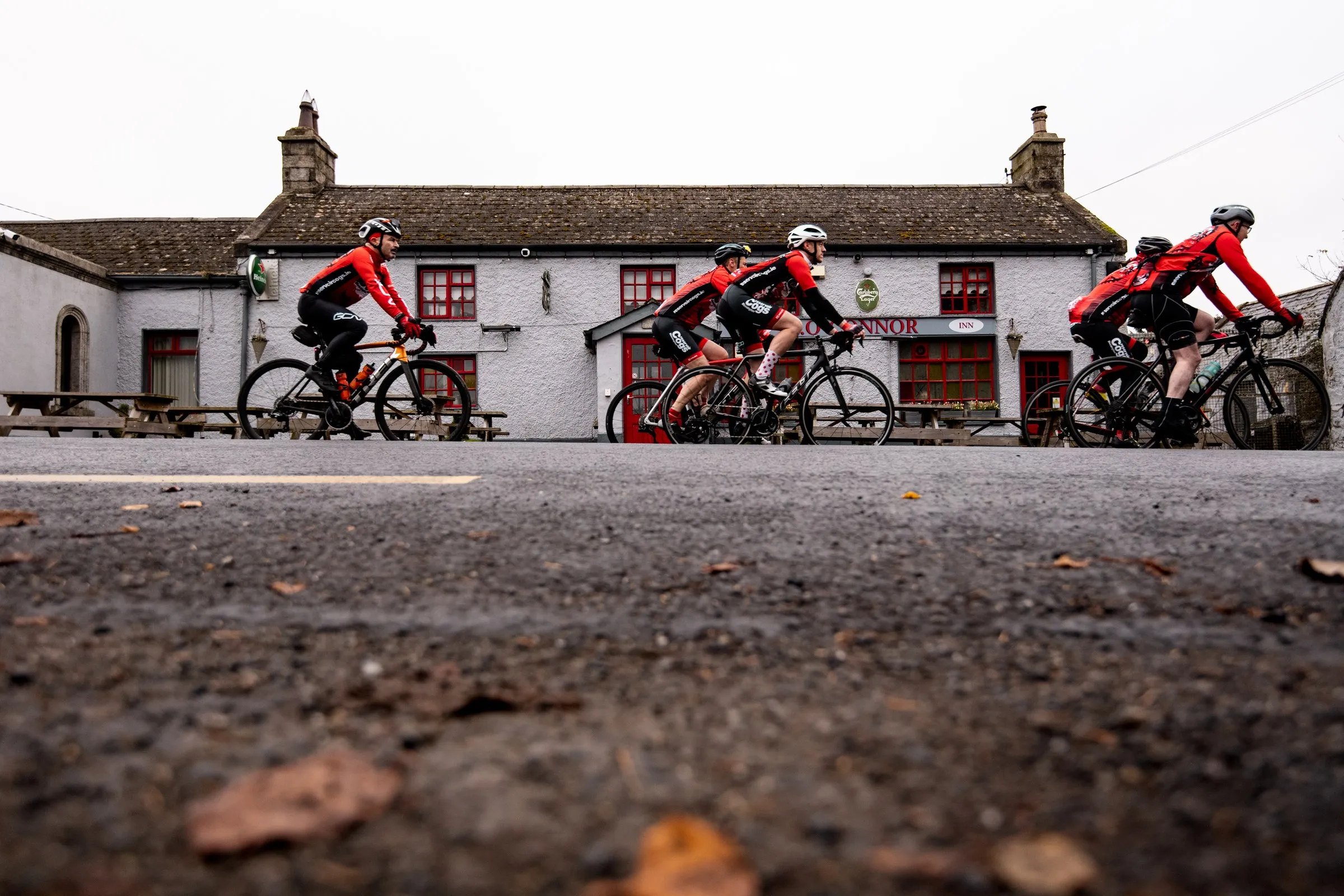
Every August a handful of cyclists roll away from Trim Castle in County Meath and do not stop until they have gone right round the island. The Race Around Ireland (RAI) is 2,150 km of coast road, ridden without stage breaks. Solo riders spend up to 22 hours a day in the saddle. Relay teams rotate riders and keep the bike moving through the night.
The weather does what it likes. That is most of the difficulty.
What is the Race Around Ireland?
RAI is a non-stop, self-supported cycling race that follows a coastal loop around the island, starting and finishing in Trim, County Meath. First held in 2009, the event has grown into a recognised qualifier for the Race Across America, the benchmark ultra-cycling race. The route varies only marginally year-to-year, ensuring a consistent challenge while allowing organisers to adapt for road works or safety concerns.
Key facts:
| Detail | Information |
|---|---|
| Distance | Approx. 2,150 km (about 1,335 mi) |
| Total climbing | Roughly 22,000 m (72,000 ft) |
| Start/finish | Trim, County Meath, Trim Castle backdrop |
| Typical start date | Last weekend in August |
| Open to | Solo riders, open-bike solos, tandems, 2-, 4- and 8-person teams |
| Crew | Mandatory support vehicle for solo riders; crew can also compete as volunteers |
Riders decide their own rest, nutrition and pacing strategies. Solo participants often spend up to 22 hours a day in the saddle, while relay teams rotate riders to keep the bike moving 24 hours a day.
Route Highlights
The loop hugs the coast for most of its length. Below are the main waypoints; exact distances are in the official routebook.
| Region | Notable Landmark | Approx. Distance from Start |
|---|---|---|
| Meath | Trim Castle, historic town of Trim | 0 km |
| Leinster | Newgrange (Boyne Valley), ancient passage tomb | 60 km |
| North-East | Belfast, Titanic Quarter and the Giant’s Causeway (World Heritage) | 250 km |
| North-West | The Dark Hedges (Haunted avenue of beech trees) | 320 km |
| Co. Donegal | Malin Head, northernmost point of Ireland | 460 km |
| Co. Sligo | Benbulben, dramatic “table mountain” | 560 km |
| Co. Galway | Connemara’s rugged coastline, Cliffs of Moher (southern part) | 830 km |
| Co. Kerry | The Ring of Kerry, Mizen Head, southern tip | 1,260 km |
| Co. Wicklow | “Garden County”, lush valleys, Wicklow Mountains | 1,620 km |
| Back to Meath | Moynalty finish line, Trim Castle again | 2,150 km |
The waypoints also tell you where the work is. The Wicklow Mountains mean steep climbs. The Causeway Coast means wind. You can have sun on the south coast and fog in the north on the same afternoon, so plan loosely.
Categories & Time Limits
RAI offers several competition classes, each with its own time allowance (the maximum time to finish the full distance). All participants must complete the route within the allotted window to be classified as finishers.
| Category | Max Time (Solo) | Max Time (Team) |
|---|---|---|
| Solo Women | 144 hours (6 days) | - |
| Solo Men | 132 hours (5 ½ days) | - |
| 2-Person Relay | - | 132 hours |
| 4-Person Relay | - | 96 hours (4 days) |
| 8-Person Relay | - | 96 hours |
| Irish Ultra Challenge (half-distance, 1,100 km) | 74 hours (Women) / 68 hours (Men) | - |
Teams can be mixed-gender and mixed-ability, making the event popular with corporate groups and charity crews. The crew, the support vehicle and its driver(s), are a vital part of the race; they provide food, mechanical assistance and morale boosts.
Preparing for the Race
1. Build a Base
- Mileage: Aim for 2,000–3,000 km per month in the 3–4 months leading up to the race.
- Long rides: Include at least one 8–10 hour ride per week, progressively extending to 12 hours.
- Climbing: Simulate the 22,000 m elevation gain by training on hilly terrain or using a turbo trainer with programmed gradients.
2. Back-to-Back Days
Ultra-events demand sustained effort. Practice back-to-back long rides (e.g., 6 hours Saturday, 8 hours Sunday) to teach your body to recover on the move.
3. Sleep Management
- Short naps: Train to nap for 20-30 minutes while riding or during brief stops.
- Caffeine strategy: Test caffeine timing and dosage in training to avoid crashes on race day.
4. Nutrition Trials
- Calorie target: 300–400 kcal per hour is typical for ultra-cycling.
- Food types: Use a mix of solid foods (energy bars, sandwiches, rice cakes) and liquids (electrolyte drinks, carbohydrate gels). Practice the exact foods you plan to use, ensuring they sit well in your stomach.
5. Bike Fit & Equipment
A time-trial/tri-bike is popular for its aerodynamic advantage, but a gravel bike offers comfort on rough coastal roads. Ensure:
- Saddle: Choose a well-padded, proven saddle; consider a cut-out to reduce pressure.
- Handlebars: Aerobars for solo riders; flat bars or a mix for team relays.
- Tire choice: 28-32 mm tyres at 80–100 psi for a balance of speed and comfort; tubeless setup reduces puncture risk.
6. Mechanical Skills
Solo riders must be able to repair flats, broken chains and brake issues without external help. Practice quick-change kits and carry a spare wheel or tyre.
Gear & Nutrition Essentials
| Item | Recommended Specs |
|---|---|
| Bike | Time-trial, tri-bike or gravel bike, carbon or aluminium frame, integrated brakes |
| Helmet | Aerodynamic, well-ventilated, MIPS technology optional |
| Clothing | Moisture-wicking jersey, arm/leg warmers, waterproof jacket (lightweight), full-length bib shorts |
| Shoes | Clip-on road shoes with breathable socks; consider shoe covers for rain |
| Lights | Front 1000 lumens, rear 300 lumens, plus spare batteries |
| Navigation | GPS bike computer (Garmin Edge, Wahoo) + paper routebook (mandatory) |
| Nutrition | Energy gels (30 g carbs each), high-energy bars, dried fruit, nuts, banana, peanut butter packets, electrolyte tablets, isotonic drink |
| Hydration | 1 L water bottle + 1 L insulated bottle; plan refill points at towns |
| Tools | Multi-tool, spare tube, CO₂ cartridges, mini-pump, chain link, tire levers |
| Medical kit | Blister pads, ibuprofen/acetaminophen, anti-nausea tablets, allergy medication |
Crew Gear
Crew vehicles should carry spare parts, additional food, a portable power bank for charging devices, and a first-aid kit. A portable toilet (or “squat” kit) is useful for remote sections.
Records & Notable Achievements
A few of the performances are worth knowing about before you set your own target.
| Year | Rider | Country | Time | Avg Speed (km/h) |
|---|---|---|---|---|
| 2009 | Joe Barr | Ireland | 108 h 12 m | 19.70 |
| 2012 | Bernd Paul | Germany | 106 h 14 m | 20.63 |
| 2013 | Christoph Strasser | Austria | 93 h 16 m | 23.69 (Fastest solo ever) |
| 2017 | Nicole Reist | Switzerland | 125 h 45 m | 19.71 (First woman to lead home all solo finishers) |
| 2018 | Joe Barr | Ireland | 104 h 3 m | 20.74 |
| 2019 | Pierre Bischoff | Germany | 101 h 55 m | 21.19 |
The average speed of winning solo riders typically sits between 19–22 km/h, but the record-breaking 23.69 km/h by Strasser shows what is possible with meticulous preparation and optimal conditions.
Practical Tips for Participants
- Study the routebook: It contains turn-by-turn instructions, road numbers and hazard notes. Memorise the first 50 km; after that, rely on the book and GPS.
- Plan refill points: Identify towns where you can top-up water, eat solid food and change tyres if needed. The route passes major towns roughly every 80–120 km.
- Weather watch: Irish weather can change in minutes. Pack water-proof layers and a thermal hat for the north-west coast where winds are strongest.
- Sleep hacks: Use a neck pillow and eye mask for quick naps. Keep a light-weight sleeping bag in the crew vehicle for longer rests.
- Mental strategies: Break the race into “segments” (e.g., “Trim to Belfast”). Celebrate each segment finish to maintain morale.
- Safety first: Wear high-visibility clothing, especially on dark rural roads. Use bike lights from the start; Irish daylight fades early in August.
- Legalities: Ensure your bike is road-legal (lights, reflectors, a bell). Carry your insurance and a photocopy of your passport/ID in case of border checks.
Why Take Part: Cyclist or Crew?
- Personal achievement: Completing a 2,150 km without a stage break puts you in a small group of people who have done it.
- Scenic reward: Few races take you past Newgrange, the Giant’s Causeway and the Cliffs of Moher in one go.
- Charity potential: Many riders raise funds for local charities, leveraging the race’s high-profile status.
- Team building: Corporate crews often use RAI as a team-building exercise, testing communication, problem-solving and endurance under pressure.
- Crew experience: Supporting a rider offers a unique perspective, you become the logistics hub, learn mechanical skills, and share the triumph at the finish line.
Conclusion
Most of what decides your race happens before the start: hours in the saddle, a bike you can sit on for five days, food you have already tested, and a crew who know what to do at three in the morning. The 93-hour record is not the point for most entrants. Finishing inside the time limit is.
Check the official Race Around Ireland website for registration dates, routebook downloads and FAQs.