Hike and Bike: Ireland's Combined Adventure Routes
Five itineraries pairing a ride with a walk, from Slea Head and the Dingle Way to the Waterford Greenway and the Copper Coast. Grading and kit notes.
Introduction
Ireland’s waymarked walking trails and its greenways often run through the same country, sometimes within a few kilometres of each other. That makes it straightforward to ride one day and walk the next without shifting base. The bike covers the ground; the boots get you to the places the bike cannot reach.
It also gives you an out. When the rain settles in for a full day, and at some point it will, a 20 km walk is a good deal more bearable than 80 km into a headwind.
Why Combine Hiking and Cycling?
| Benefit | How it Enhances Your Trip |
|---|---|
| Varied scenery | Cycle along coastal roads for sweeping ocean views, then hike inland trails to explore hidden glens and ancient stone forts. |
| Flexibility | Swap a long bike day for a gentle walk when the weather turns rainy, or add an extra cycling leg to make up for a missed hike. |
| Fitness balance | Cycling builds endurance while hiking develops strength and balance, together they give a full-body workout without over-taxing either muscle group. |
| Cultural immersion | Bike into villages for a quick coffee, then wander on foot through local markets, churches and craft workshops. |
| Efficient travel | Cover up to 80 km by bike in a day, then use the evening for a 10-km walk, maximising the number of attractions you can see. |
Choosing the Right Route
When planning a hike-and-bike adventure, consider these factors:
- Region and landscape: West coast (Wild Atlantic Way), South (Beara & Ring of Kerry), East (Ancient East), or the North (Donegal).
- Season: Summer offers longer daylight, but spring and early autumn provide milder temperatures and fewer crowds.
- Difficulty mix: Pair an “easy” bike day with a “moderate” hike, or vice-versa, to keep daily exertion balanced.
- Transport links: Proximity to airports (Dublin, Shannon, Cork, Belfast) and public transport (bus, rail) simplifies start-and-finish logistics.
- Support services: Look for routes with luggage transfer, bike-hire shops, and B&Bs that cater to active travellers (many in the Ireland Walk Hike Bike network).
Five itineraries follow, each pairing an established walking trail with a greenway or a set of quiet lanes close enough to reach from the same bed.
Top Combined Hike-and-Bike Itineraries
1. Dingle Peninsula: Slea Head Loop & Dingle Way (County Kerry)
- Cycling: 35 km Slea Head Loop, a coastal ride passing Ventry, Coumeenoole Beach and the Gallarus Oratory. Mostly paved, with short climbs; an e-bike takes the sting out of them.
- Hiking: 45 km section of the Dingle Way (from Dingle to Dunquin), rugged cliffs, ancient beehive huts and panoramic views of the Blasket Islands. The walk is graded moderate with some steep ascents.
- Best time: Late May to early September (sunny days, sea breezes).
- Logistics: Base in Dingle town, a hub of B&Bs, bike-rental shops and pubs with live traditional music. Luggage can be transferred daily via local van service.
2. Ring of Kerry & Gap of Dunloe: Cycle Loop & Kerry Way (County Kerry)
- Cycling: 70 km Ring of Kerry loop on quiet secondary roads and the Moll’s Gap climb (≈300 m). The route offers sweeping views of the MacGillycuddy’s Reeks and the Skellig Coast.
- Hiking: 30 km stretch of the Kerry Way from Kenmare to Killarney, a mix of forest tracks, lakeside paths and the dramatic Gap of Dunloe boardwalk. Graded easy-moderate.
- Best time: Late spring (April-June) when wildflowers bloom and traffic is lighter.
- Logistics: Stay in Kenmare for two nights; a local bike-hire centre provides road and mountain bikes, plus e-bike options for the steeper sections.
3. Beara Peninsula: Greenway Cycle & Beara Way (Counties Cork & Kerry)
- Cycling: 100 km Beara Peninsula Loop, a combination of the Beara Greenway (newly upgraded, traffic-free) and scenic country lanes. Highlights include Dursey Island cable car and the Sheep’s Head cliffs.
- Hiking: 120 km Beara Way (circular), well-marked waypoints through Allihies, Eyeries and Gougane Barra. The trail is moderate with some steep ascents to coastal ridges.
- Best time: Early September to early October, once the summer traffic has thinned and the temperatures have dropped.
- Logistics: Use Allihies as a base; many B&Bs offer bike storage and shuttle services for luggage.
4. Waterford Greenway & The Copper Coast: Cycle & Walk (County Waterford)
- Cycling: 46 km Waterford Greenway, a former railway line that runs from Waterford City to Dungarvan. Smooth, level surface, perfect for families and e-bike riders. Passes the historic Mount Congreve Gardens and the dramatic Copper Coast cliffs.
- Hiking: 20 km Copper Coast Trail (Dungarvan to Ballycotton), a coastal walk with sea-stack views, sea-cave explorations and the chance to spot seals. Graded easy with a few short climbs.
- Best time: Late May to early July, long daylight and wildflowers along the cliffs.
- Logistics: Waterford City offers plentiful accommodation, bike-rental shops, and a daily luggage-transfer service that moves gear between hotels and the trailhead.
5. Connemara: Sky Road Cycle & Western Way (County Galway)
- Cycling: 41 km Sky Road, a ridge-top route overlooking Connemara Bay and the Twelve Bens. Mostly paved, with a few steep sections; an e-bike is worth having for the climb to Mweelrea.
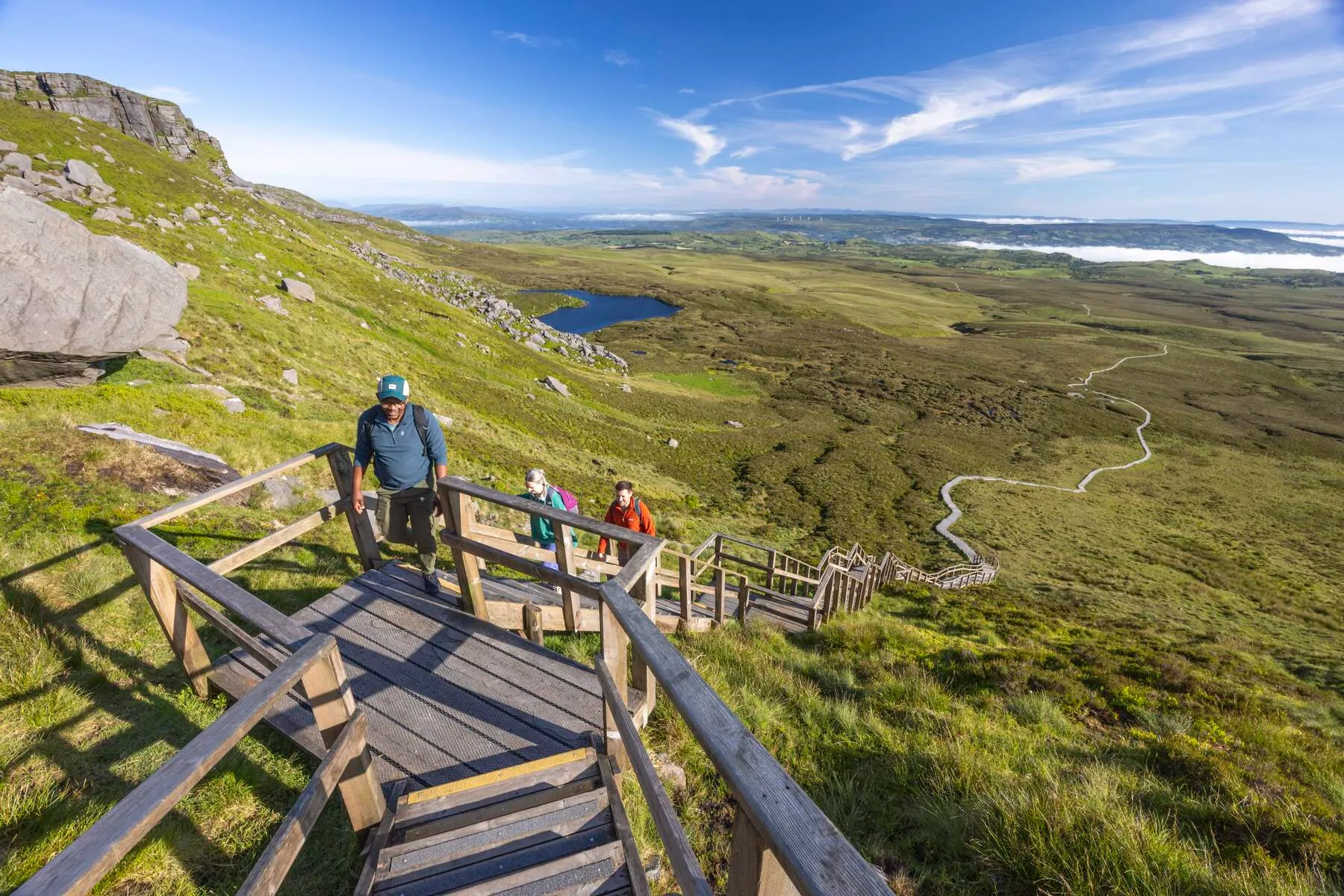
- Hiking: 85 km Western Way (from Clifden to Leenaun), a mix of bogland boardwalks, mountain passes and lakeside paths. Graded moderate-hard with some river crossings.
- Best time: Late June to early August, when the bogs are dry and mountain weather is most stable.
- Logistics: Stay in Clifden; local hostels and guesthouses provide secure bike storage. A bike-to-bus service runs between Clifden and the Sky Road trailhead.
Planning Tips for a Seamless Hike-and-Bike Holiday
1. Grading System
Many Irish providers (including Ireland Walk Hike Bike) use a simple three-tier grading:
| Grade | Typical Daily Distance | Terrain |
|---|---|---|
| Gentle | 10-15 km walk / 30-40 km ride | Flat coastal roads, well-maintained paths |
| Moderate | 15-25 km walk / 50-70 km ride | Rolling hills, occasional gravel sections |
| Energetic | 25-35 km walk / 80-100 km ride | Steep climbs, mixed surface (mountain bike, boardwalk) |
Choose a mix that matches your group’s fitness and preferred pace.
2. Packing Essentials
| Item | Reason |
|---|---|
| Waterproof jacket & trousers | Ireland’s weather changes rapidly, rain can arrive in minutes. |
| Layered clothing (base, fleece, shell) | Allows easy temperature control during bike climbs and walk descents. |
| Sturdy walking boots (broken-in) | Essential for boggy boardwalks and rocky mountain sections. |
| Padded cycling shorts & gloves | Increases comfort on longer rides, especially on rough country lanes. |
| Daypack (15-20 L) | Holds water, snacks, rain gear, map/phone, and a small first-aid kit. |
| Portable charger & GPS device | Offline maps (e.g., OSi Maps or Komoot) work without mobile signal. |
| Reusable water bottle | Tap water is safe throughout Ireland; refill at pubs or cafés. |
3. Luggage Transfer
For multi-day itineraries, consider a daily luggage-transfer service. Companies (e.g., Ireland Walk Hike Bike, Cycle Ireland) collect your bags each evening from the accommodation and deliver them to the next day’s start point, freeing you to travel light on bike and on foot.
4. Bike Hire and E-Bike Options
- Urban hubs (Dublin, Cork, Galway) have large rental fleets, including e-mountain bikes for steep sections.
- Rural shops on the west coast often provide hybrid or gravel bikes suited to mixed surfaces.
- Pre-book at least 7 days in advance during peak season (June-August).
5. Accommodation
- B&Bs and guesthouses are the most common in rural Ireland; many offer home-cooked breakfasts with local produce.
- Farm stays put you well off the main road and often include fresh milk, cheese and storytelling evenings.
- For longer routes, consider hostels in larger towns (e.g., Dingle, Waterford) that provide bike racks and communal kitchens.
6. Getting There and Getting Around
| Airport | Nearest combined route | Typical transfer |
|---|---|---|
| Dublin (DUB) | Waterford Greenway (via Dublin-Cork rail) | Train to Waterford (≈2 h) + bus/taxi to trailhead |
| Shannon (SNN) | Beara Peninsula (via Killarney) | Bus to Killarney (≈45 min) + shuttle to Allihies |
| Cork (ORK) | Beara Peninsula & Ring of Kerry | Direct bus to Kenmare or Allihies |
| Belfast (BFS) | Donegal (Western Way) | Train to Derry + bus to Letterkenny |
Rent a car only if you plan to explore off-trail villages; otherwise, public transport + luggage-transfer works well and reduces carbon impact.
Sustainable Travel Practices
- Stay on marked paths: protects fragile bogs and archaeological sites.
- Carry out all litter: use refillable containers to reduce waste.
- Support local businesses: purchase food, crafts and accommodation from the communities you visit.
- Choose e-bikes where possible, they lower emissions and make steep climbs accessible to a broader range of travellers.
- Offset your carbon footprint: several Irish tourism organisations (e.g., Sustainable Tourism Ireland) offer easy offset schemes.
Sample 7-Day Itinerary: Dingle Peninsula + Kerry Way
| Day | Activity | Distance (walk/ride) | Highlights |
|---|---|---|---|
| 1 | Arrival in Dingle, bike set-up | 20 km ride (easy) | Dingle town, pubs, Slea Head sunrise |
| 2 | Walk Dingle Way (Dingle-Dunquin) | 22 km walk (moderate) | Blasket Islands viewpoint, ancient beehive huts |
| 3 | Cycle Slea Head Loop | 35 km ride (moderate) | Coumeenoole Beach, Gallarus Oratory |
| 4 | Transfer to Kenmare, bike to Gap of Dunloe | 45 km ride (moderate) | Spectacular mountain scenery |
| 5 | Hike Kerry Way (Kenmare-Killarney) | 30 km walk (easy-moderate) | Torc Waterfall, Muckross House |
| 6 | Rest day, explore Killarney town, optional boat tour | - | Traditional music session in a local pub |
| 7 | Departure from Kerry Airport (KTR) | - | Reflect on the adventure with a final Irish breakfast |
Adjust distances based on fitness level; e-bike usage can reduce perceived effort on Days 3 and 4.
Final Thoughts
Alternating the two keeps you fresher than a week of either on its own. Walking days use different muscles, and they give the saddle a rest.
The practical bits matter more than the route choice. Book bike hire at least seven days ahead between June and August, arrange the luggage transfer at the same time, and pack for rain regardless of what the forecast says. Boots need to be broken in before you get on the plane, not after.