Road Cycling Etiquette in Ireland
The law on lights, positioning and passing, plus the unwritten rules for group riding, narrow rural roads and busy city junctions in Dublin and Cork.
Introduction
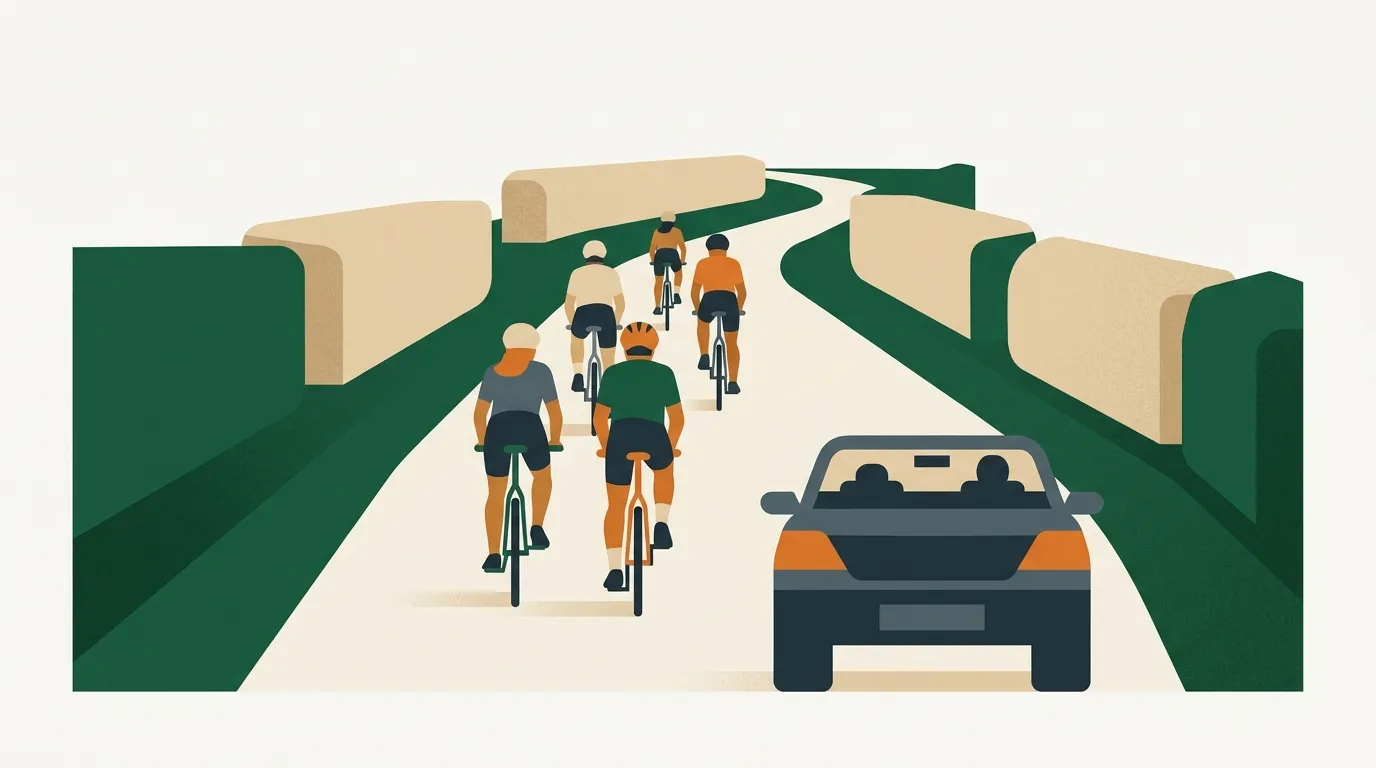
Irish roads are narrow, hedged and often have no hard shoulder at all. That is much of what makes the country good to ride through, and it is also why the gap between you and an overtaking van is smaller than either of you would like. Most trouble comes down to two things: being seen, and being predictable.
The information here is drawn from Cycling Ireland, the RSA, Transport for Ireland, and the Citizens Information service. The legal requirements come first. The unwritten rules, which account for most of the day-to-day friction, come after.
Key takeaway: In Ireland cyclists have the same rights and responsibilities as drivers, but because we are more vulnerable we also need to be extra visible, predictable and courteous.
1. Legal framework: what the law says
| Area | Legal requirement | What it means for you |
|---|---|---|
| Road classification | All public roads are governed by the Road Traffic Act 1994 and the Road Traffic (Traffic and Parking) Regulations 1999. | You may ride on any public road unless a sign specifically prohibits cyclists (e.g. some motorways). |
| Obligatory equipment | Regulation 27 (Road Traffic (Safety) (Motor Cycle) Regulations), required: front white light, rear red light, reflectors, bell, and a fully functional brake system. | Check your bike before every ride, a working bell, lights (min. 15 lux front, 5 lux rear) and reflectors on pedals, wheels and rear. |
| Helmet | Not compulsory for adults, but strongly recommended (Road Safety Authority). | Wear a certified EN 1078 helmet, it reduces head injury risk by up to 70 %. |
| Alcohol | Same limits as drivers: 0.5 g/L (blood) or 0.25 mg/L (breath). | If you’re unsure, avoid riding after drinking. |
| Mobile phone | Section 46, using a handheld phone while riding is an offence. | Use a bike-mounted mount or stop safely before answering. |
| Pedal-powered vs. electric | E-bikes up to 250 W and 25 km/h are classed as bicycles; higher power requires a motor-vehicle licence. | Keep your e-bike within limits, otherwise you’ll need a licence, insurance and tax. |
Statistical note: In 2023, 13 % of all road traffic collisions in Ireland involved a cyclist, with 60 % of those resulting in personal injury. Most accidents occur where cyclists are not visible or predictable. (RSA, 2024)
2. Core etiquette: the “unwritten” rules
2.1 Positioning on the road
| Situation | Best practice |
|---|---|
| Straight-ahead riding | Ride as far right as practicable, but leave at least 1 m clearance from the curb when the lane is narrow or the surface is uneven. |
| Leaving a roundabout | Stay in the centre of the lane (like a car) to be seen and to avoid being squeezed. |
| Overtaking | Signal early, move to the left side of the lane, and give at least 1.5 m clearance to the vehicle overtaking you. |
| Narrow lanes | If the lane is too narrow for a car and bike side-by-side, take the lane (ride centre) and signal your intention. This prevents cars from “squeezing” you and reduces side-swipe risk. |
| Roadworks / obstacles | Slow down, signal, and ride on the left side of the obstruction unless signs direct otherwise. |
2.2 Signalling
| Signal | How to perform | When to use |
|---|---|---|
| Left turn | Extend left arm, bent elbow, hand open. | Before any left-hand turn or to signal a left-hand lane change. |
| Right turn | Extend right arm, straight, hand open or left arm bent with hand pointing down. | Before any right-hand turn or lane change. |
| Stop / slowing | Extend left arm, palm down, moving up-and-down. | When you need to stop or slow sharply (e.g., traffic light, obstacle). |
| Hazard warning | Both arms out, palms forward. | To alert drivers of a danger ahead (e.g., pothole, animal). |
| Overtaking | Wave left arm upward. | To thank a driver who lets you pass. |
Tip: Keep signals clear and early, at least 3 seconds before the manoeuvre, and maintain them until the action is complete.
2.3 Interaction with other road users
- Cars: Give drivers a clear line of sight. If a driver signals you to “take the lane”, politely thank them with a wave. Never “squeeze” between a car and a parked vehicle.
- Pedestrians: Yield when they are on a crossing or sidewalk. Use your bell gently, a loud ring can startle walkers.
- Other cyclists: Pass on the right (same direction as traffic) unless overtaking on a narrow stretch where you both share the lane.
- Motorcyclists: Treat them as you would any other vehicle, give at least 1 m clearance when passing.
3. Visibility: making yourself seen
| Element | Recommendation | Reason |
|---|---|---|
| Clothing | Bright colours (fluorescent yellow, orange, neon green) + retro-reflective tape on the back, shoulders and legs. | In low-light conditions, colour alone can be missed; reflectors bounce headlights back to drivers. |
| Lights | Front white ≥ 15 lux, rear red ≥ 5 lux; both steady (flashing is allowed but not mandatory). | Legal minimum and ensures you’re visible from 200 m away. |
| Helmet lights | Small front light mounted on helmet helps drivers see the rider’s head position. | Reduces “head-in-shadow” effect when riding on the right side of the lane. |
| Reflectors | Pedal, shoe, wheel, and rear-reflector required by law. Add extra spokes or tyre reflectors for night rides. | Increases visibility from multiple angles. |
| Bike accessories | Bell, rear-view mirror (optional), helps you see overtaking traffic. | Early awareness of hazards, reduces surprise. |
Stat: According to the RSA, cyclists using front and rear lights are 38 % less likely to be involved in a night-time crash.
4. Safety tips for different riding environments
4.1 Urban riding (e.g., Dublin, Cork)
- Plan routes using quieter side streets or dedicated cycle lanes (e.g., Dublin’s Cycle Superhighways).
- Watch for dooring: position yourself away from parked cars, and look for opening doors.
- Traffic lights: treat them as you would a car; stop fully and look both ways before proceeding.
4.2 Rural and scenic routes (e.g., Wild Atlantic Way)
- Surface awareness: gravel, potholes, and wet stones are common. Reduce speed and keep a firm grip.
- Wind: strong cross-winds can push you off course; stay low and keep both hands on the hoods.
- Animals: be prepared for livestock or wildlife crossing; signal and give them space.
4.3 Group rides
- Ride single file on narrow roads, keeping a safe distance (2–3 m) between riders.
- Use a “lead-car” or designated navigator with a map or GPS.
- Communicate: a simple “slow”, “stop”, or “left” shouted ahead of a turn keeps everyone coordinated.
5. De-escalation and conflict resolution
- Stay calm: an angry response can provoke a dangerous situation.
- Make eye contact when possible; a friendly wave can diffuse tension.
- If a driver behaves aggressively, pull over safely, note the vehicle registration, and report to An Garda Síochána.
- Use the “Safe Cycling Charter” (Cycling Ireland) as a reference when discussing etiquette with other road users.
6. Quick checklist before you ride
| ✅ | Item |
|---|---|
| 1 | Lights (front & rear) functional, batteries charged |
| 2 | Helmet properly fitted, straps tightened |
| 3 | Reflectors on pedals, wheels, rear |
| 4 | Bell audible from 15 m |
| 5 | Tyres inflated to recommended pressure |
| 6 | Brakes checked, both front and rear respond |
| 7 | Clothing bright, weather-appropriate |
| 8 | Mobile phone secured or left at home |
| 9 | Route planned, know any restrictions |
| 10 | Hydration and snacks (especially on long rides) |
Conclusion
None of this is complicated. Lights that work. A hand out before you turn. A lane taken rather than shared when the road is too narrow to share. Drivers cope well with a cyclist they can see and whose next move they can guess, and badly with one who appears from nowhere.
Remember: Predictability + Visibility = Safety. That holds whether you are commuting through the city, grinding up a hill in the Wicklow Mountains, or riding the coast road.