Cycling the Burren: A Karst Landscape by Bike
The 69 km Burren Cycleway, a 30 km dolmen loop and four options from the Doolin hub. Bare limestone, little shelter, rare flowers in the cracks.
Introduction
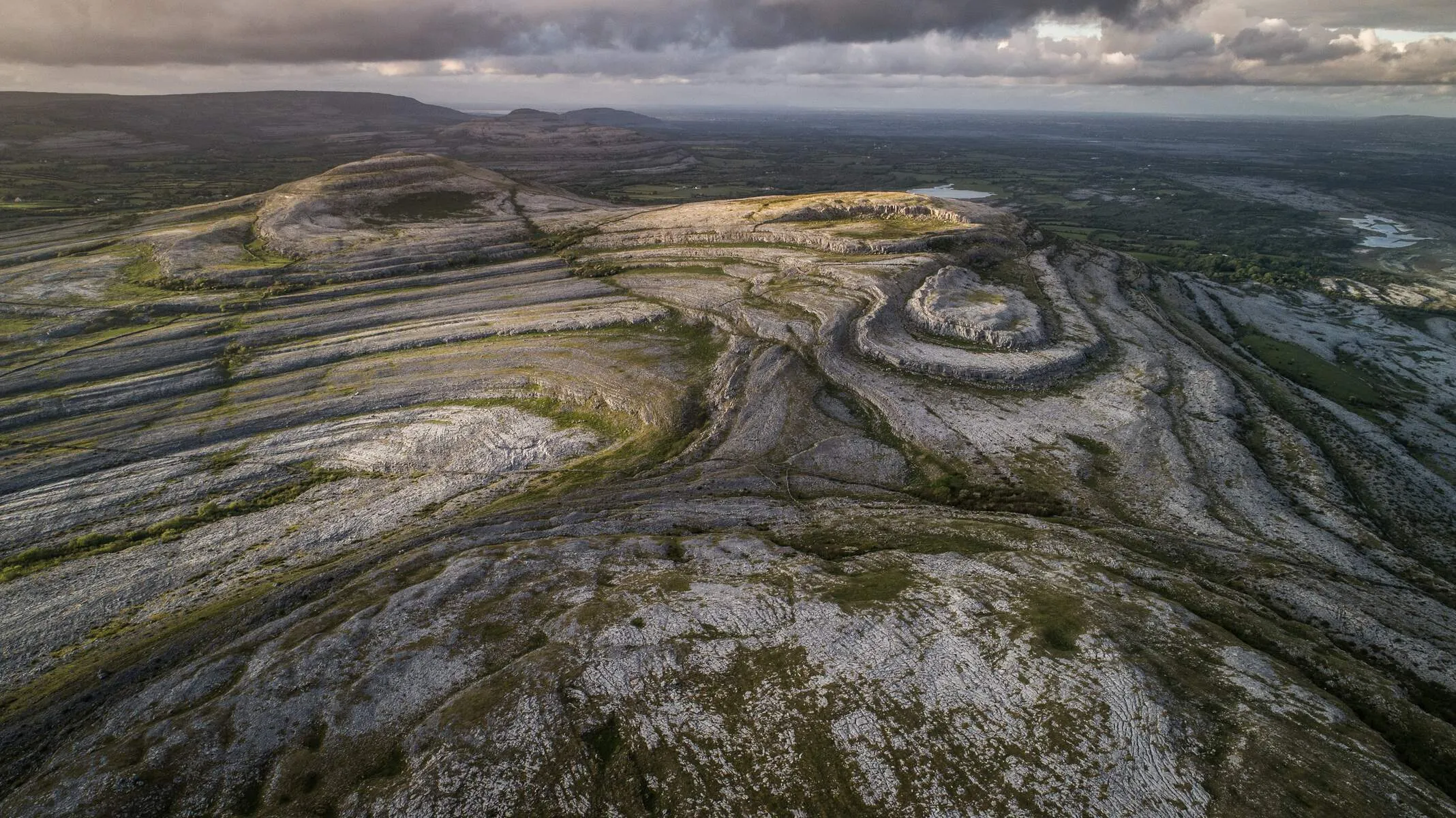
The Burren is bare limestone. Grey slabs split by fissures, thin grass, and not much standing between you and the Atlantic wind. People reach for the word “lunar” and it has stuck. What matters on a bike is more prosaic: the routes are well marked and run past stone monuments and open sea-views, the climbs need the low gears, and there is next to no shelter anywhere on them.
The Burren’s Lunar Landscape
Karst geology
The Burren is a classic karst region, formed over 350 million years ago when limestone was uplifted and then eroded by rainwater and wind. The result is a network of grykes (deep fissures) and clints (flat slabs) that give the ground a cracked, almost metallic texture. Under a bright sun, the pale stone reflects a silvery-grey glow that many visitors liken to the surface of the Moon.
Climate and light
The Burren’s Atlantic exposure means it enjoys relatively low rainfall compared with the rest of western Ireland, but the weather can change in minutes. Clear, sunny days bring crisp, high-contrast light that accentuates the limestone’s colour and makes the landscape appear almost surreal. In winter, low-angle light and occasional mist add a haunting, lunar quality that is equally photogenic.
Flora that thrives in the cracks
Despite its barren appearance, the Burren supports an extraordinary mix of Arctic-alpine and Mediterranean plants growing side-by-side in the grykes. Species such as rock-rose, spring gentian, wild thyme and the rare Irish orchid create colourful patches that burst from the grey stone, especially after a spring rain.
Cycling Routes: From Moon-Walks to Coastal Sprints
1. The Burren Cycleway (69 km)
- Start/Finish: Lahinch (west coast) to Lisdoonvarna (inland), the route can be done as a loop returning to Lahinch or as a point-to-point ride.
- Difficulty: Moderate to difficult; about 2 000 m of total ascent.
- Time: Typically 1½ days for the full loop, allowing for stops at landmarks.
- Terrain: Hilly, with long climbs on low gears and sections of narrow country lanes. Traffic is light outside of the peak summer months.
- Highlights: Cliffs of Moher viewpoint, the Poulnabrone Dolmen, Leamaneh Castle, and the dramatic Black Head lighthouse.
This is the one people mean by the “lunar ride”. Long stretches with bare limestone on both sides of the road, then the Atlantic air arrives without warning at the coast.
2. Dolmen Cycleway (≈ 30 km loop)
- Start/Finish: Lisdoonvarna.
- Difficulty: Moderate to difficult; steady climbs but shorter than the Burren Cycleway.
- Time: About 5-6 hours for the full loop, perfect for a day trip.
- Terrain: Similar hilly profile, but the route stays closer to the interior limestone pavement, offering more intimate encounters with the grykes.
- Highlights: Poulnabrone Dolmen, Kilfenora Cathedral, Doolin Cave, and several hidden geosites marked on the Burren Geopark map.
Because the loop returns to the same village, it’s ideal for cyclists who want a full-day experience without changing accommodation.
3. Doolin Cycle Hub (four options, 18-47 km)
| Loop | Distance | Approx. Time | Main Features |
|---|---|---|---|
| Loop 1 | 18 km | 1.5-2 h | Coastal road to the Cliffs of Moher, sea-views, wildlife spotting |
| Loop 2 | 26-39 km | 3-4 h | South-west corner of North Clare, dramatic cliffs and beach access |
| Loop 3 | 43 km | 4-4.5 h | Inland to Kilfenora and the heart of the Burren |
| Loop 4 | 21-47 km | 4.5-5 h | Northward along the coast, views of the Aran Islands |
All loops are well-signposted, have frequent stopping points for food and drink, and are suitable for riders of medium fitness who prefer shorter, more varied rides.
Practical Tips for a Successful Lunar Ride
When to Go
| Season | Weather | Pros | Cons |
|---|---|---|---|
| Spring (April-June) | Mild, occasional showers | Wildflowers in full bloom, longer daylight | Some grykes can be slippery when wet |
| Summer (July-August) | Warm, longest days | Ideal for full-day loops, sea-breeze on coastal sections | Higher tourist traffic on popular sections |
| Autumn (September-October) | Cool, crisp, fewer crowds | Golden light, comfortable temperatures | Weather can become unpredictable |
| Winter (Nov-Mar) | Cold, frequent rain, limited daylight | Dramatic mist-filled lunar atmosphere | Shorter riding windows, some services close |
For the classic “lunar” light, aim for late spring or early autumn when the sun is lower in the sky and the limestone reflects a silvery hue.
Bike Set-up
- Bike type: A sturdy road or gravel bike with clearance for wide tyres (32-38 mm) is ideal. The terrain can be rough on paved sections, so a bit of tyre width adds comfort.
- Gearing: Low gears are essential for the sustained climbs; a compact crank (50/34) or a 2×9/10 speed set-up works well.
- Brakes: Disc brakes are recommended, especially on wet days when the limestone can become slick.
- Extras: Carry a mini-pump, spare tube, multi-tool, and a water-proof pannier for snacks, a warm layer and a map (paper or offline GPS).
Navigation
The Burren Geopark provides an interactive cycling map that can be downloaded as a PDF. It marks the three main routes, points of interest, cafés and public toilets. Many cyclists also use the Strava or Komoot routes (e.g., “Burren 65 km” on Strava) for turn-by-turn guidance. Mobile signal can be spotty in the deepest limestone valleys, so a printed map as backup is advisable.
Accommodation & Food
- Lisdoonvarna: a hub of B&Bs, hostels and the Lisdoonvarna Caravan & Camping Park.
- Ballyvaughan: charming guesthouses with sea-views, perfect for the end of the Burren Cycleway.
- Doolin: famous for traditional music pubs, a range of inns and the Doolin Hostel.
- Lahinch: surf-town with many hotels and self-catering apartments.
Most villages have pubs serving hearty Irish fare (stew, fish & chips, local cheese) and cafés with vegetarian options. Stock up on water and snacks before heading into the more remote sections, as shop opening hours can be limited.
Safety and Etiquette
- Wear a helmet: mandatory for cyclists under 18 and strongly advised for all.
- Leave No Trace: the Burren is a protected UNESCO Global Geopark; pack out all litter and stay on marked roads or designated paths.
- Watch for livestock: sheep and cattle often graze near the road; give them space, especially during lambing season (March-May).
- Weather readiness: carry a waterproof jacket and warm layers; wind can gust strongly on exposed ridges.
- Emergency services: the nearest ambulance station is in Ennis; carry a mobile phone with a local SIM and note the emergency number 999.
Flora, Fauna and Geological Highlights
Plant life in the grykes
The fissures shelter micro-climates where alpine plants survive far south of their normal range. Look out for:
- Spring Gentian (Gentiana verna): vivid blue flowers that appear in early summer.
- Rock-rose (Helianthemum nummularium): bright yellow blooms hugging the limestone.
- Irish Orchid (Orchis purpurea): a rare purple orchid that can be spotted on well-drained grykes.
Wildlife
- Peregrine falcons and buzzards often circle the cliffs.
- Red deer may be seen grazing near the higher uplands.
- Marine life: Dolphins and seals are occasionally sighted from the coast, especially near Doolin and the Cliffs of Moher.
Geological landmarks
- Poulnabrone Dolmen: a 5,000-year-old portal tomb, often called the “Gateway to the Moon”.
- Leamaneh Castle: a ruined tower house perched on a limestone ridge.
- Black Head Lighthouse: a striking white tower offering panoramic sea views.
- Cliffs of Moher: though technically outside the core Burren area, they are frequently included in the coastal loops for their dramatic contrast to the inland limestone.
The Experience: Why the Burren Feels Like Riding on the Moon
What you notice first is how much you can see. The lack of dense vegetation means the view runs for kilometres in every direction, and the blues of the Atlantic are the only strong colour in it. Some riders find that exhilarating. Others find it relentless, and on a grey day they have a point.
The riding wants attention rather than power. The grykes are slippery when wet and the hills need a steady cadence rather than sprinting. It is a harder day than the distances suggest.
Planning Your Lunar Cycle Holiday
- Choose your route: For a multi-day adventure, combine the Burren Cycleway with the Dolmen Cycleway, staying overnight in Lisdoonvarna and Ballyvaughan. For a day trip, pick one of the Doolin Cycle Hub loops.
- Book accommodation early: Summer is the busiest period; secure rooms by May for July-August travel.
- Rent a bike locally if needed: Several bike shops in Lahinch and Doolin offer gravel-bike rentals equipped with panniers.
- Check the weather forecast: The Met Éireann website provides 7-day forecasts; aim for a day with clear skies and light winds for the best lunar effect.
- Pack smart: Waterproof jacket, layers, sun cream, sunglasses, and a compact first-aid kit.
Conclusion
The Burren asks more of a rider than most Irish routes of the same length. That is the limestone, the wind and the climbing, in roughly that order. Take the 69 km Burren Cycleway, the Dolmen loop or one of the coastal Doolin routes, then pick your day. Clear skies and light winds turn the stone silver. Rain makes the grykes slippery and the whole place grey.
Bring low gears and a waterproof. The rest of it is stone.